
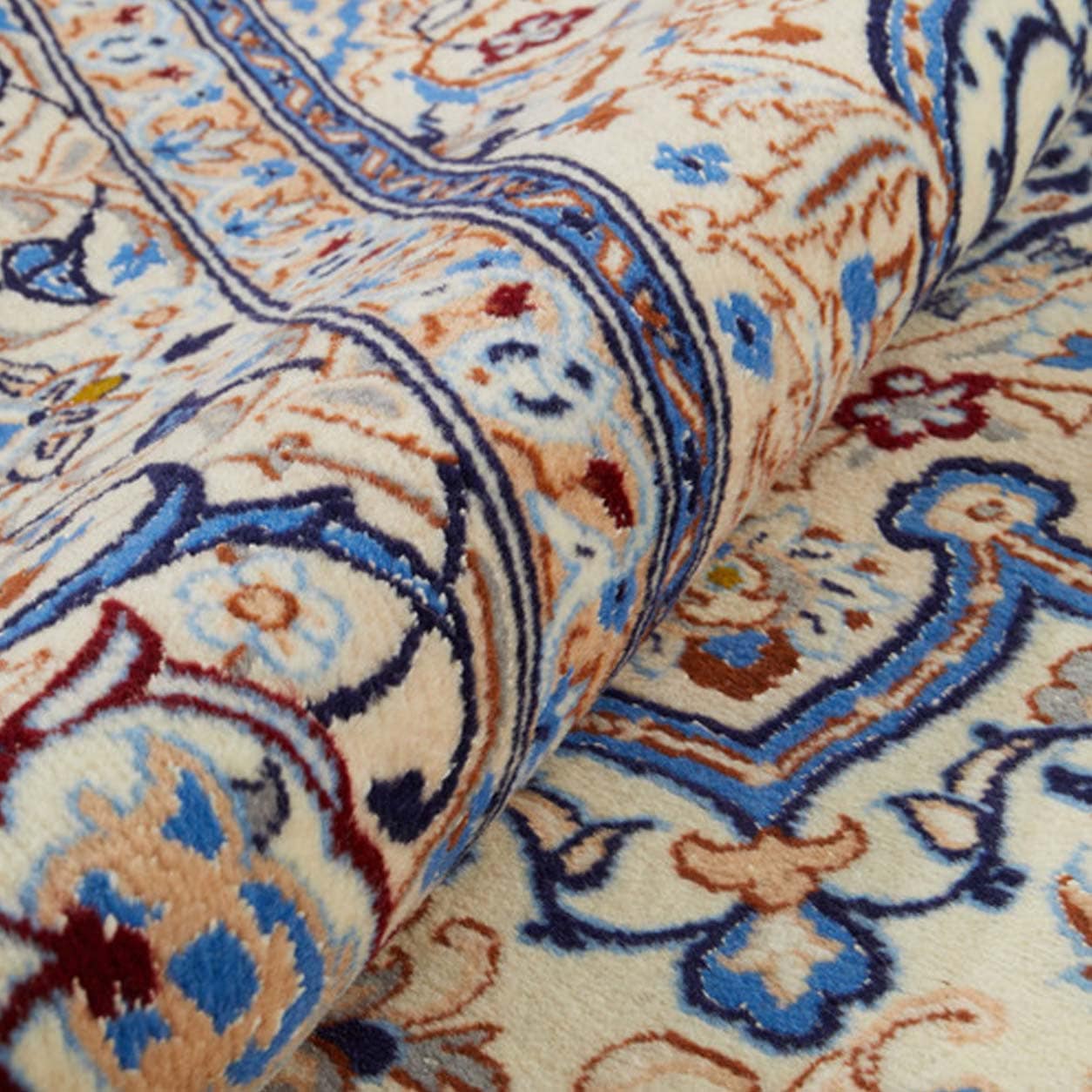

Nain Rugs: Refined Persian Elegance in Blue and Ivory
Persian Nain rugs are known for exceptionally precise drawing, restrained colour and fine wool-and-silk construction. Their most recognizable palette combines ivory or cream with navy, indigo, pale blue and beige. Classical examples often feature a central medallion surrounded by scrolling arabesques, Shah Abbasi palmettes, vines and small blossoms, with silk used to illuminate selected outlines and details.
Compared with the centuries-old carpet traditions of cities such as Kashan and Kerman, Nain’s reputation as a major rug-weaving centre is relatively recent. The industry developed largely during the twentieth century, yet it quickly established a distinctive visual identity and a technical grading vocabulary—4La, 6La and 9La—that is now recognized by collectors worldwide.
About the City of Nain
Nain—also written Na’in, Naein or Nayin—is a historic desert city in Isfahan Province in central Iran, situated between Isfahan and Yazd. Its mud-brick neighbourhoods, qanat water systems, traditional houses and early congregational mosque reflect an architecture adapted to an arid climate. Archnet dates important parts of the Great Mosque of Nain to the late tenth century, with remnants from an earlier phase. Before carpet weaving became prominent, the city was celebrated for fine woollen textiles and aba cloaks. Nain’s quiet desert palette and sophisticated architectural ornament offer an evocative parallel to the ivory grounds, cool blues and disciplined arabesques of its carpets.
The Modern History of Nain Carpet Weaving
Nain carpet weaving emerged as older textile industries declined during the early twentieth century. Local makers redirected skills in wool preparation, spinning, dyeing and textile production toward hand-knotted carpets. Designs drew from the refined curvilinear traditions of nearby Isfahan while gradually developing a recognizable Nain identity.
By the mid-twentieth century, Nain rugs had become established in Iranian and international markets. Workshops produced fine wool carpets with silk highlights, precise medallions and a narrower palette than many other Persian weaving centres. This consistency made the rugs easy to recognize, although it also encouraged copies made outside the city.
The history should be described carefully. Nain is not an ancient Safavid carpet centre in the same sense as Isfahan or Kashan. Its importance lies in the speed with which a twentieth-century industry achieved high technical standards and created a design language that now feels inseparable from the wider story of Persian carpets.
Fathollah Habibian and the Workshop Tradition
Fathollah Habibian is widely associated with the development of high-quality modern Nain weaving. Rugs attributed to his workshop are admired for disciplined design, fine construction, carefully placed silk and balanced blue-and-ivory colour. His name is sometimes woven into a carpet or cited in sales descriptions.
A signature alone is not proof of authorship. Workshop inscriptions can be copied, misunderstood or added to pieces of different quality. A serious Habibian attribution should consider the signature, structure, materials, drawing, date, condition and documented provenance together. Not every excellent Nain is a Habibian, and the fame of a workshop should never replace inspection of the rug itself.
What Makes a Nain Rug Distinctive?
Common characteristics include:
A central medallion with matching corner elements
Shah Abbasi flowers, palmettes, vines and arabesques
Ivory, cream, navy and pale blue as dominant colours
Fine wool pile on a cotton foundation in many examples
Silk outlines or highlights that emphasize flowers and curves
Asymmetrical Persian knotting
Low, neatly clipped pile that keeps the design clear
Fine workshop drawing and carefully organized borders
La classifications such as 4La, 6La and 9La
These traits are useful clues, not a guarantee of origin. Rugs made elsewhere may reproduce the Nain palette and medallion style. Geographic attribution should also consider construction, finishing and provenance.
Materials and Construction
Fine Wool Pile
Most Nain rugs use fine wool as the principal pile material. Good wool provides softness, resilience and subtle light reflection. The pile is usually clipped relatively low so that small blossoms, thin stems and silk outlines remain crisp. Very soft wool is sometimes described in the trade as kork, but the term is not applied consistently and should be treated as a claim requiring examination.
Cotton Foundations
Cotton is common for the warps and wefts because it creates a stable foundation for dense, accurate knotting. The warps continue beyond the body of a hand-knotted carpet to become the fringe. This is important in Nain rugs because the construction of the fringe is used when discussing the La grade.
Silk Highlights
Silk is often used selectively in flowers, medallion outlines, arabesques or other details. Its sheen changes with the angle of light and gives the pattern depth. The amount of silk varies widely. A carpet with silk accents should not be described as an all-silk rug, and product listings should identify pile, warp and weft materials separately.
Persian Knot
Nain rugs commonly use the asymmetrical knot, also known as the Persian or Senneh knot. It permits smooth curves and dense curvilinear ornament. The knot is found in many Iranian regions, however, so it cannot prove Nain origin by itself.
Understanding the Nain La System
The word La means “layer” or “ply.” In Nain rug terminology, it refers to the component strands that form the foundation yarn visible in the fringe. The system is connected with structural fineness: a lower La number generally indicates a finer foundation and greater potential for closely spaced knots and miniature detail.
La is not the same as knot density. Two rugs described as 6La may have different numbers of knots per square inch because warp spacing, vertical row count, tension and workshop standards vary. La also does not establish age, silk content, maker, artistic quality or market value.
4La Nain Rugs
Four-La represents an exceptionally fine and relatively rare structural category. These rugs can support miniature drawing and extremely delicate curves. Because genuine examples are uncommon, a 4La claim should be verified by an experienced specialist rather than accepted from a label or photograph.
6La Nain Rugs
Six-La rugs are associated with very fine workshop production. They often combine dense knotting, fine wool, silk highlights and precise floral design. A strong 6La can be collector quality, but condition and artistry still determine desirability.
9La Nain Rugs
Nine-La is widely encountered and can offer an excellent balance of refinement, durability and price. A well-made 9La rug is not “low quality.” It may be more suitable for normal floor use than an extremely delicate piece and can still display elegant medallions, clear arabesques and attractive silk detail.
12La and Other Trade Labels
Twelve-La appears in parts of the market for a relatively heavier Nain foundation. The label is less consistently applied than 6La or 9La. Buyers should examine the actual fringe, back and knotting instead of relying only on the product title.
How to Check a Claimed La Grade
The grade is normally assessed through an original fringe because the fringe is an extension of the warp foundation. A specialist may gently separate a small area to study how many fine component strands form the yarn. Fringes that are tightly twisted, shortened, repaired or replaced can make the conclusion difficult.
Do not cut, pull apart or aggressively untwist a fringe. It is a structural part of the carpet, and damage can weaken the end. For valuable rugs, request clear macro photographs and obtain direct examination by an experienced professional.
Classic Nain Rug Designs
Medallion and Corner Design
The classic Nain composition centres on a round, star-shaped or lobed medallion, often with pendants at the top and bottom. Coordinated corner pieces echo the centre. The surrounding field is filled with scrolling vines and flowers, producing an ordered architectural effect.
Shah Abbasi Flowers and Arabesques
Stylized palmettes, lotus-like blossoms and split-leaf arabesques connect Nain rugs to the classical decorative vocabulary of Persian art. Fine knotting and silk outlines allow each curve and petal to remain distinct.
All-Over Floral Design
Some Nains replace the dominant medallion with a continuous field of flowers and vines. This creates an even rhythm and works well beneath dining tables or furniture arrangements where a central motif would be partly hidden.
Dome and Mosque-Inspired Patterns
Radial designs can resemble the decorated underside of an Iranian mosque dome. Repeating bands of arabesques and flowers expand from a central point, giving the rug a luminous, architectural quality.
Tree of Life and Prayer Rugs
Tree of Life designs may show a flowering tree, birds, cypress forms and vases. Prayer rugs are organized around an arched mihrab and may include lamps, columns, flowers or inscriptions. The precision of Nain weaving suits these vertically structured compositions.
Pictorial Rugs
Some workshops create landscapes, portraits, architecture and scenes inspired by Persian miniature painting. Faces, lettering and perspective reveal the quality of both the original cartoon and the weaving.
Colours and Visual Character
Nain is famous for a restrained palette. Ivory or cream may dominate the field, balanced by navy, indigo, medium blue, pale blue, beige and brown. Red, green, turquoise or gold are often used only as small accents. Dark outlines give pale flowers definition, while silk catches light selectively.
Not every genuine Nain is blue and ivory, and colour alone cannot confirm origin. Later production and rugs woven in a Nain style may use broader palettes. Natural-dye claims also require evidence; age, washing and light exposure can change both plant-based and synthetic colours.
Abrash—subtle variation between yarn or dye batches—may appear in a handwoven rug. Gentle tonal movement can add character, while severe fading, bleeding or isolated recoloured areas require close inspection.
Nain, Nain-Style and the “Nain Tudeskh” Label
The success of Nain design encouraged production in surrounding areas and beyond Iran. A carpet can be hand-knotted and attractive while still being Nain-style rather than woven in Nain itself. Product descriptions should distinguish design from documented origin.
The trade label “Nain Tudeskh” or “Nain Tudeshk” is used for rugs associated with the Tudeshk area near Nain and for certain Nain-related commercial qualities. Usage varies between markets. It should not be treated as a universally standardized grade, and the individual rug’s structure and provenance remain essential.
How to Identify an Authentic Persian Nain Rug
Confirm that the pile is individually hand-knotted rather than machine-made or glued into a tufted backing.
Examine the back for fine curvilinear drawing, knot structure, repairs and material changes.
Identify the pile, warps and wefts separately and verify where silk is used.
Check that the fringe continues from the internal foundation rather than being sewn on decoratively.
Study the medallion, arabesques, palette, borders and finishing as a complete group of evidence.
Request clear photographs of the front, back, fringe, sides and any signature.
Ask for provenance supporting Nain, Tudeshk, workshop or age claims.
Verify any advertised La grade rather than assuming it from knot density.
Obtain a written condition report covering pile loss, moth damage, stains, colour run, foundation breaks and restoration.
A rug woven outside Iran may reproduce the Nain look beautifully, but it should be described as “Nain design” rather than as an authentic Persian Nain.
How to Evaluate Quality Before Buying
Drawing: Are the curves smooth and the smallest flowers clearly resolved?
Composition: Do the medallion, field, corners and borders feel balanced?
Wool: Does the pile feel resilient rather than dry, brittle or overly processed?
Silk: Is natural silk accurately identified, and is its placement refined?
Colour: Are ivory, blues and accents harmonious and stable?
Structure: Does the carpet lie flat without severe buckling or distortion?
La claim: Has the foundation been examined correctly?
Condition: Is original pile preserved, especially in the centre and along fold lines?
Restoration: Are repairs stable, skilful and disclosed?
Provenance: Are claims about Habibian, age and geographic origin supported?
Use: Is the rug durable enough for the planned traffic and furniture?
Knot count and La should inform the evaluation, not dominate it. A beautiful, well-preserved 9La may be more desirable than a damaged or poorly designed 6La.
Decorating with a Nain Rug
Nain’s ivory-and-blue palette works naturally with pale wood, stone, neutral upholstery and modern interiors. The rug can add intricate detail without overwhelming a room. Navy grounds create a more formal anchor, while ivory fields make small or darker spaces feel lighter.
A medallion rug works best when furniture placement respects the centre. An all-over pattern is easier beneath a dining table. Measure the room, furniture footprint and door clearance before buying, and use a compatible rug pad to reduce movement and uneven wear.
Care and Preservation
The Canadian Conservation Institute recommends low-suction vacuuming without a rotating power head and moving in the direction of the pile. Fringes, loose yarn and silk details should be protected from suction.
Rotate the rug periodically to distribute sunlight and foot traffic.
Keep it away from persistent moisture, damp floors and plant containers.
Blot spills immediately with a clean absorbent cloth; never rub.
Avoid bleach, household stain removers, powders and steam machines.
Use a cleaner experienced with fine wool-and-silk Persian carpets.
Inspect the back and edges regularly for moth activity.
Never pull a loose thread or cut a projecting knot yourself.
Store the rug clean and dry, rolled around a wide support rather than folded.
Place very fine, silk-rich, antique or weakened examples in lower-traffic rooms.
Value and Collecting
Nain rugs range from practical decorative carpets to rare workshop pieces. Value depends on La grade, actual knot density, materials, dimensions, design, age, condition, restoration, workshop, signature, provenance and current demand.
A low La number or famous name does not guarantee financial appreciation. For an important purchase, request a detailed invoice and consider an independent appraisal. The strongest choice is a rug whose attribution is honest and whose beauty, size and condition suit its intended home.
Final Thoughts
Persian Nain rugs prove that a relatively modern tradition can achieve a timeless identity. Their cool blue-and-ivory colours, exact medallions, silk-lit arabesques and fine foundations combine technical discipline with quiet elegance.
Choose a Nain by looking beyond the familiar palette and the La number. Study the front, back and fringe; confirm where silk is used; examine condition and restoration; and ask how origin and workshop claims were established. A carefully selected Nain can bring the precision of Persian city weaving into both classical and contemporary interiors.
At Maison Perse, each Nain rug can be presented with detailed photographs, accurate dimensions and transparent information about materials, La grade, condition, age, restoration and provenance.
Frequently Asked Questions
Which spelling is correct: Nain, Na’in or Naein?
All are transliterations of the same Iranian city name. “Nain” is the most common spelling in the international rug trade.
Are Nain rugs antique?
Most belong to a comparatively modern twentieth-century tradition. Some are vintage or collectible, but Nain is not an ancient carpet centre in the same sense as Kashan.
What does La mean in a Nain rug?
La means layer or ply and refers to the component strands in the foundation yarn visible through the fringe. A lower number generally indicates a finer foundation.
Is 4La better than 6La or 9La?
Four-La is generally finer and rarer, but final quality and value also depend on design, materials, condition, size, workshop and provenance.
Is a 9La Nain a good rug?
Yes. A well-made 9La can be fine, elegant and more practical for household use than a highly delicate collector piece.
Does La tell the exact knot count?
No. La describes the foundation yarn. Knot density must be measured separately.
Are all Nain rugs made with silk?
No. Many use wool pile with selective silk highlights. The amount and location of silk vary, and some pieces contain none.
What colours are typical of Nain rugs?
Ivory, cream, navy, indigo, pale blue and beige are most characteristic, with smaller red, green, turquoise or gold accents.
Does a Habibian signature prove authenticity?
No. It should be supported by structure, materials, drawing, age and documented provenance.
Can a Nain rug be used every day?
A sound wool-based Nain can suit normal use with a proper pad and careful maintenance. Very fine, silk-rich or weakened pieces need protected placement.

