
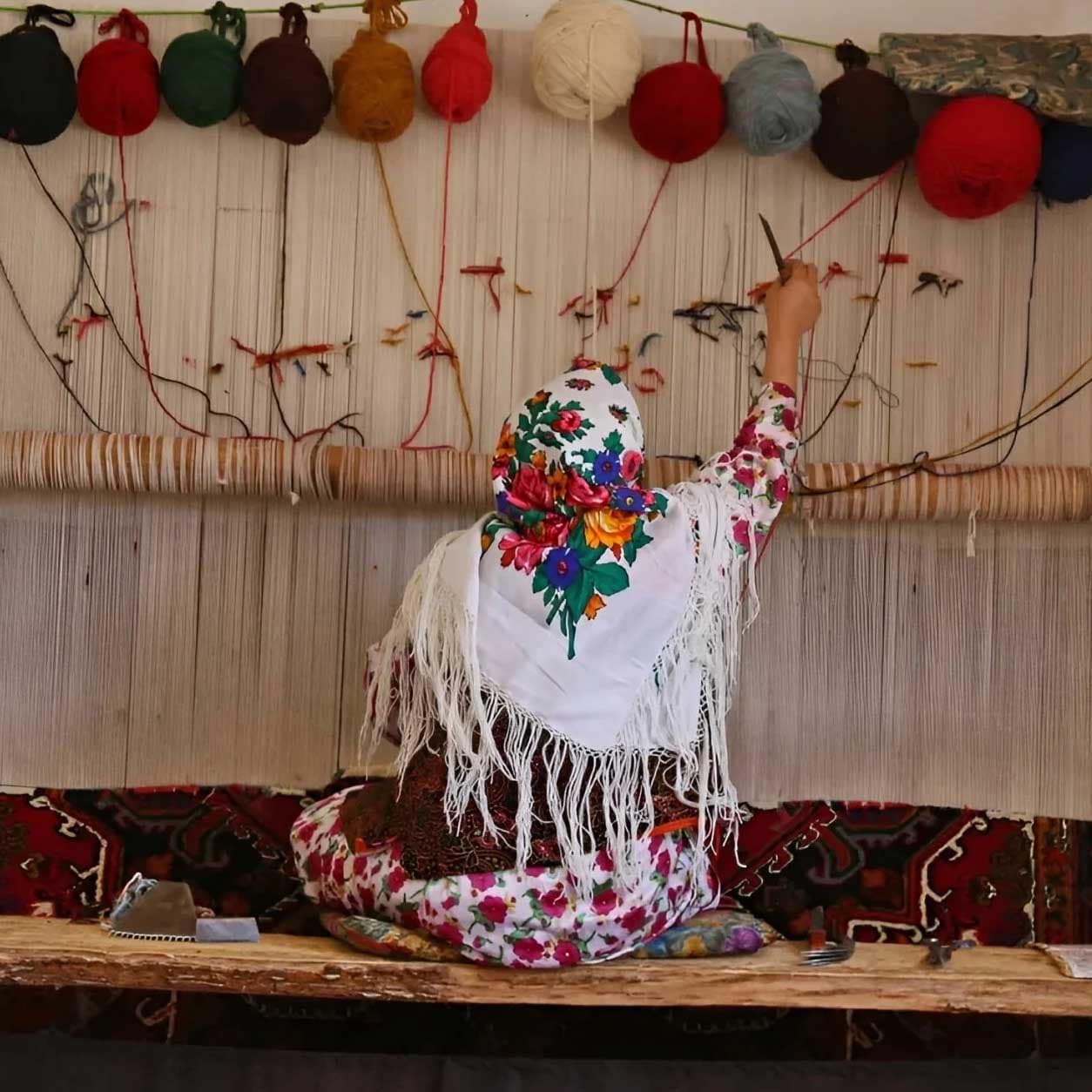

Bakhtiari Rugs: Bold Gardens Woven in the Zagros Mountains
Persian Bakhtiari rugs are loved for strong construction, saturated colour and designs that turn the carpet field into an idealized garden. Their best-known pattern divides the surface into compartments filled with flowering trees, cypress forms, roses, birds and animals. Other examples use medallions, prayer niches, repeating trees, geometric flowers or expressive tribal motifs.
The name “Bakhtiari” requires careful explanation. Encyclopaedia Iranica notes that the label is applied to a wide range of pile and flatwoven textiles from southwestern Iran and functions more as a territorial than a strictly ethnic designation. Rugs sold under the name may have been woven by Bakhtiari nomads, settled Bakhtiari villagers or other communities within the Chahar Mahal region. A responsible description should therefore distinguish geographic style, community and documented provenance whenever possible.
About the Bakhtiari Region and Shahr-e Kord
The Bakhtiari homeland lies in the central Zagros Mountains of western and southwestern Iran. Chaharmahal and Bakhtiari Province is characterized by high ranges, cold winters, valleys, oak-covered slopes and seasonal pastures. Shahr-e Kord is the provincial capital and an important centre for the organization and trade of regional carpets. Historically, Bakhtiari pastoral groups moved between summer quarters in the high Zagros and winter territories toward Khuzestan. The contrast between mountain life and cultivated valleys helps explain why gardens, water channels, flowering plants and trees carry such visual power in the region’s carpets.
A Regional Tradition, Not One Single Workshop Style
Bakhtiari weaving includes both nomadic and settled production. The Metropolitan Museum of Art describes large pile carpets as mainly associated with sedentary village groups, while portable bags and related textiles were also woven by nomads. Highly stylized animal, floral and vegetal motifs appear across these objects.
Commercial production expanded in Chahar Mahal villages during the late nineteenth and early twentieth centuries. Towns and markets helped connect local weavers with merchants and international buyers. Shahr-e Kord, Farrokhshahr, Farsan, Juneqan and other centres became involved in weaving, wool preparation, dyeing and trade.
No single technical rule separates every nomadic Bakhtiari rug from every village carpet. Iranica records useful tendencies—such as double-wefted, symmetrically knotted wool-foundation rugs being associated with tribal production and single-wefted cotton-foundation examples with village manufacture—but also warns that actual structures vary. Each carpet must be examined individually.
What Makes a Bakhtiari Rug Distinctive?
Common characteristics include:
Compartment, garden or “brick” designs filled with different plants and animals
Rich red, blue, green, ivory, brown and yellow-orange palettes
Strong wool pile suited to regular household use
Symmetrical knotting in many documented examples
Wool foundations in numerous tribal pieces
Cotton foundations in many village and commercial carpets
Cypress trees, willows, roses, boteh, birds and horned animals
Broad borders that repeat floral or geometric elements from the field
Slight variations in motifs and colour that reveal hand production
These features are clues, not proof. Similar designs occur in Luri and other western Iranian weaving traditions, and Bakhtiari patterns have been copied outside the region.
The Famous Chahar Bagh or Garden Design
Chahar bagh means “four gardens” and refers broadly to the Persian concept of a garden divided by paths or water channels. In rug-market language, the term is often used for Bakhtiari carpets whose fields are divided into an organized grid of compartments.
Each panel may contain a different image: a cypress tree, flowering bush, willow, rose, vase, bird, deer or abstract plant. The grid gives the rug architectural order, while the changing motifs keep it lively. This design is also called kheshti, meaning “brick” or compartment, because the field resembles rows of decorated tiles.
Not every compartment carpet is literally a four-part garden, and not every kheshti rug is Bakhtiari. The terms describe a design family rather than proving origin. A complete attribution also depends on weave, materials, palette, finishing and provenance.
Classic Bakhtiari Rug Designs
Kheshti or Compartment Pattern
The field is divided into squares, rectangles, diamonds or irregular panels. Repetition may be strict or deliberately varied. The strongest examples balance many individual motifs without losing the overall rhythm of the grid.
Cypress and Tree Designs
Cypress trees can represent endurance and are closely connected with Persian garden imagery. They may appear in compartments, offset rows or Tree of Life compositions. Willows and flowering trees add softer curves to the otherwise geometric structure.
Medallion and Corner
Village workshops also produced carpets with central medallions and coordinated corner pieces. Bakhtiari versions often feel bolder and more geometric than the highly curvilinear medallions of Isfahan or Nain.
Prayer Rugs
Prayer carpets organize the field around an arched mihrab. The Metropolitan Museum preserves a late nineteenth- or early twentieth-century Bakhtiari example from western Iran made entirely of wool with symmetrical knots. Regional prayer rugs may include trees, vases, columns, animals or geometric floral forms.
Lion and Figural Designs
Some Chahar Mahal carpets display heraldic lions, human figures, hunting subjects or animals. The lion has deep associations with courage, authority and Iranian visual culture. Figural designs should be assessed for drawing and composition, not only knot count.
Boteh and Repeating Motifs
Boteh forms, hooked diamonds, rosettes and repeating trees may cover the field. Some motifs overlap with Luri and neighbouring traditions, which is why design alone cannot always establish provenance.
Tribal Rugs, Village Carpets and Chahar Mahal Labels
“Bakhtiari” and “Chahar Mahal” overlap in the rug trade but are not perfectly interchangeable. Bakhtiari can refer to an ethnic group, a wider territory or a commercial style. Chahar Mahal more often identifies village production from the district and province associated with Shahr-e Kord.
Traditional tribal pieces may use wool warps and wefts, portable formats and relatively spontaneous drawing. Village carpets may have cotton foundations, larger room sizes and designs prepared for the market. These are useful patterns, not absolute rules. Nomadic weavers have also used cotton, and village production can preserve tribal motifs.
A product listing can use a qualified description such as “Bakhtiari-style village carpet from Chahar Mahal” when that is what the evidence supports. Precision is more valuable than forcing every rug into a simple category.
Materials and Construction
Wool Pile
Bakhtiari carpets are typically valued for durable wool. Good pile feels resilient and has enough body to withstand normal traffic. Fibre quality varies by flock, season, spinning and preparation. Older rugs may have low pile from use; wear should be distinguished from deliberately low shearing.
Wool Foundations
Wool warps and wefts are characteristic of many tribal and nomadic pieces. An all-wool structure can feel flexible and may show slight irregularity from portable or traditional looms. Goat hair can appear in side finishes or utilitarian textiles.
Cotton Foundations
Many village and commercial Chahar Mahal rugs use cotton warps or wefts. Cotton provides dimensional stability and supports larger, more regular carpets. Its presence does not make a rug inauthentic, nor does wool alone prove nomadic origin.
Symmetrical Knotting
The symmetrical knot—also called Turkish or Gördes—is common in Bakhtiari weaving. The pile yarn wraps around two neighbouring warps, creating a stable structure suited to geometric drawing. Knot type is one technical clue among many and is not exclusive to the region.
Flatweaves and Mixed Techniques
Bakhtiari textile culture also includes kilims, salt bags, saddlebags, straps and other portable objects. Iranica describes a double-interlocked tapestry structure associated with some Bakhtiari flatweaves. The interlocking creates strong joins and parallel ridges on the back. A flatwoven bag or saddle textile should be identified by its original function rather than sold generically as a small rug.
Bibibaf Bakhtiari Rugs
Bibibaf is a trade term used for especially fine Bakhtiari carpets. The word is often interpreted as “woven by a respected or senior woman,” and market descriptions sometimes romanticize it as “grandmother’s weave.” Historically, the category has been associated with finer weaving and, in some cases, commissioned carpets connected with Bakhtiari khans.
The term is not a universal technical standard. It does not provide an exact knot count, village, date or maker. A rug described as Bibibaf should still be evaluated through materials, construction, design, condition, inscriptions and provenance.
Colours and Traditional Dyeing
Bakhtiari rugs are recognized for rich red and dark blue, balanced with green, ivory, brown, black, orange and yellow. Natural madder historically produced red shades, while indigo supplied blues. Iranica notes that a local plant called gandal was used for mustard yellow and, with madder, distinctive yellow-orange tones.
Later production may include synthetic dyes. Natural colour cannot be confirmed reliably from a photograph. Look for harmony, stability and the way tones have aged, and treat “vegetable dye” as a claim requiring evidence.
Abrash—variation between yarn or dye batches—is common in handmade rugs and can add depth. It is different from sun fading, chemical bleaching, dye bleed or later recolouring, all of which may affect value and care.
How to Identify an Authentic Persian Bakhtiari Rug
Confirm that the pile is individually hand-knotted rather than machine-made or tufted with adhesive.
Examine the back for knot type, weft structure, material changes and repairs.
Identify pile, warp and weft materials separately.
Study the garden compartments, secondary motifs, borders and colour as a group.
Inspect selvedges, fringes and flatwoven end finishes for original construction.
Determine whether the piece is a pile carpet, kilim, complete bag, bag face or saddle textile.
Ask for provenance connecting the rug to Chahar Mahal, western Iran or a particular village.
Treat claims such as nomadic, Bibibaf, antique or natural dye as facts requiring support.
Request a written condition report covering wear, moth damage, stains, colour run, corrosion, cuts and restoration.
A carpet woven elsewhere can reproduce the Bakhtiari garden design successfully, but it should be described as “Bakhtiari design” if Iranian origin is not established.
How to Evaluate Quality Before Buying
Composition: Does the compartment grid feel balanced at full scale?
Drawing: Are trees, flowers and animals expressive and clearly resolved?
Wool: Is the pile resilient rather than dry, brittle or excessively worn?
Colour: Are reds, blues, greens and yellows harmonious and stable?
Structure: Does the rug lie reasonably flat without serious buckling?
Foundation: Are holes, splits or weak areas disclosed?
Ends and sides: How much original finishing remains?
Restoration: Are repairs skilful, stable and reflected in the price?
Attribution: Is the rug accurately described as tribal, village, Chahar Mahal or Bakhtiari-style?
Use: Can its condition tolerate the intended room and traffic level?
Knot density matters, but it is not the defining virtue of a Bakhtiari rug. Strong design, excellent wool, honest colour and preserved structure often matter more.
Decorating with a Bakhtiari Rug
The compartment design works particularly well in living rooms and dining rooms because visual interest is distributed across the entire field. Furniture can cover several panels without destroying a central composition. Red and navy examples add warmth to pale wood and neutral upholstery, while ivory or green details can be repeated in cushions, ceramics or artwork.
Measure the room, furniture footprint and door clearance before buying. A compatible rug pad reduces movement and uneven wear. Antique or weakened rugs should not sit beneath rolling chairs, sharp furniture feet or heavy pieces that cannot be moved for cleaning.
Care and Preservation
The Canadian Conservation Institute recommends vacuuming with low suction, without a rotating power head, and in the direction of the pile. Protect fringes, loose yarn and weakened areas from suction.
Rotate the rug periodically to balance foot traffic and light exposure.
Keep it away from persistent moisture, damp floors and plant containers.
Blot spills immediately with a clean absorbent cloth; never rub.
Avoid bleach, household stain removers, powders and steam machines.
Use a cleaner experienced with Persian wool carpets and natural dyes.
Inspect the back and edges regularly for moth activity.
Never pull a loose thread or cut a projecting knot yourself.
Store a clean, dry rug rolled around a wide support rather than sharply folded.
Place rare flatweaves, bags and fragile antique pieces in protected areas or display them with appropriate support.
Value and Collecting
Bakhtiari rugs range from accessible village carpets to fine Bibibaf pieces, inscribed commissions and collectible tribal textiles. Value depends on age, rarity, design, wool, colour, size, condition, restoration, completeness and provenance.
The label alone does not guarantee investment value. For an important purchase, request a detailed invoice and consider an independent specialist. Original ends, side finishes and bag backs can be especially important when collecting older utilitarian textiles.
Final Thoughts
Persian Bakhtiari rugs transform the landscapes and cultural memory of the Zagros into bold textile gardens. Their compartment fields, cypress trees, flowers and animals combine practical structure with a remarkable sense of abundance.
The most responsible way to understand them is to look beyond a simple tribal label. Bakhtiari weaving includes nomadic objects, village carpets and commercial Chahar Mahal production, with real variation in foundations, techniques and design. Examining the entire textile—front, back, ends, materials and history—leads to a more accurate and rewarding choice.
At Maison Perse, each Bakhtiari rug can be presented with photographs of the front, back and details, together with clear information about dimensions, materials, condition, attribution, age and restoration.
Frequently Asked Questions
Where are Bakhtiari rugs made?
They are associated with western and southwestern Iran, especially the Bakhtiari region and Chaharmahal and Bakhtiari Province around Shahr-e Kord.
Are all Bakhtiari rugs woven by Bakhtiari nomads?
No. The trade name includes rugs woven by nomadic and settled communities, including non-Bakhtiari villagers within the wider region.
What is the most famous Bakhtiari design?
The kheshti or compartment garden design is the best known. Its panels contain different trees, flowers, birds, animals and vases.
What does Chahar Bagh mean?
It means “four gardens” and refers to the Persian tradition of an ordered garden divided by paths or water channels. The term is used broadly for some garden-panel rugs.
What is a Bibibaf Bakhtiari rug?
Bibibaf is a market term associated with especially fine Bakhtiari weaving. It is not a standardized knot count and should be supported by examination.
Are Bakhtiari rugs made entirely of wool?
Many tribal pieces have wool pile and wool foundations. Village carpets often have wool pile on cotton foundations. Both can be authentic.
What knot is used in Bakhtiari carpets?
The symmetrical knot is common, but structure varies and knot type alone does not prove origin.
Are Bakhtiari rugs durable?
A sound wool example can be highly practical for normal household use. Durability depends on wool, construction, condition, restoration and care.
Are all compartment rugs Bakhtiari?
No. Similar garden and compartment designs are woven in other Iranian regions and outside Iran.

