
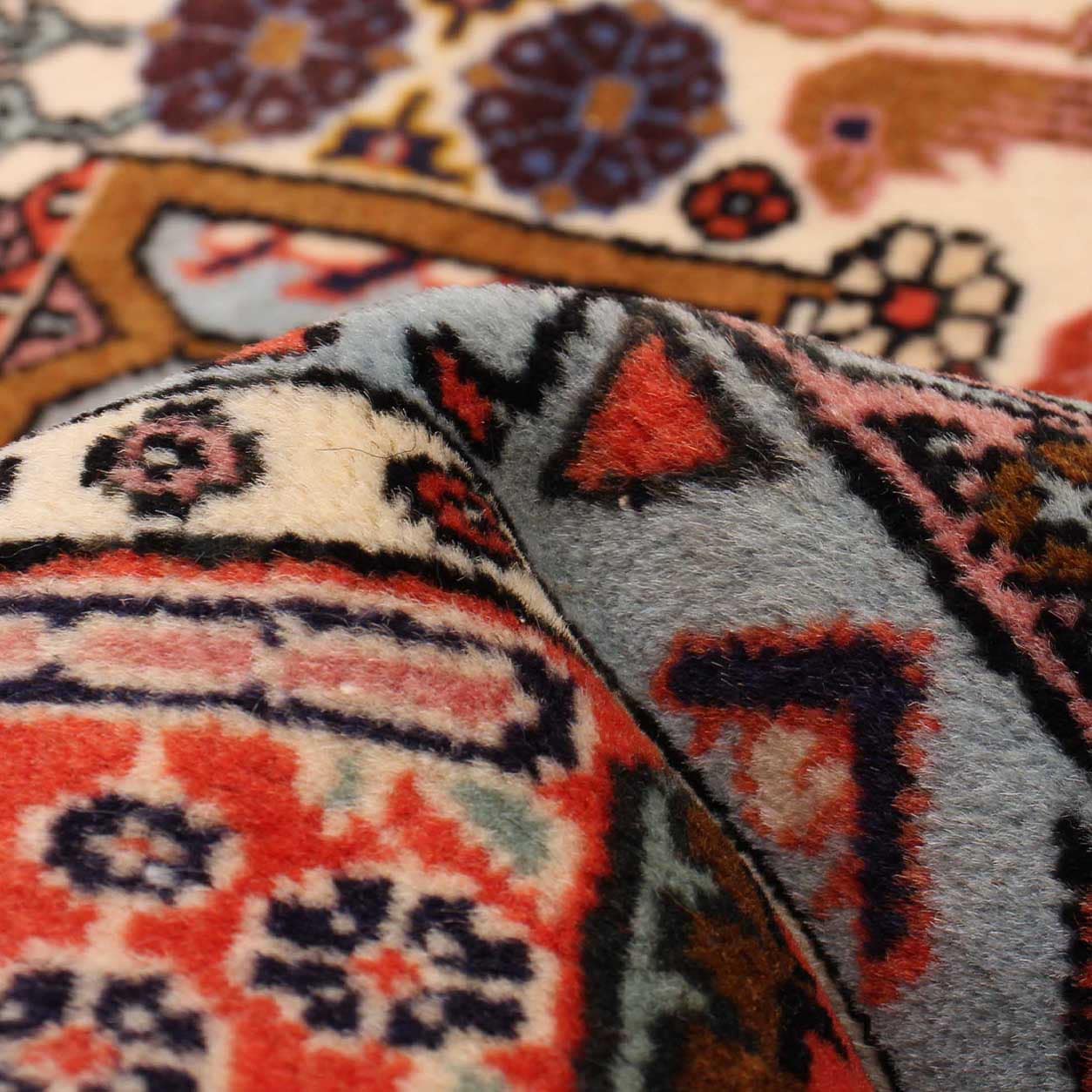

Ardabil Rugs: A Northern Iranian Tradition with a World-Famous Name
Persian Ardabil rugs belong to the varied weaving culture of Ardabil Province in northwestern Iran. The regional market includes hand-knotted village carpets, runners, kilims and tribal textiles associated with Shahsavan communities and the Moghan plain. Depending on where and by whom they were made, these textiles may feature geometric medallions, hooked diamonds, stylized flowers, animals, birds, boteh motifs or compact repeating patterns.
The name is also inseparable from the celebrated sixteenth-century Ardabil Carpet in the Victoria and Albert Museum. That masterpiece is a landmark of Safavid court art, but it should not be confused with every rug sold today as “Ardabil.” A useful guide must therefore tell two connected but distinct stories: the historic Safavid carpet associated with Ardabil’s shrine, and the diverse weaving traditions of the modern province.
About Ardabil: City, Landscape and Cultural Setting
Ardabil is an ancient city near Mount Sabalan, close to Iran’s border with Azerbaijan and the Caspian region. Its high elevation brings cold winters, while surrounding plains and mountain pastures have long supported agriculture and pastoral life. The city occupied an important position on routes connecting the Iranian plateau, the Caucasus and Anatolia, helping ideas, materials and designs circulate across the region.
Ardabil is especially important as the spiritual home of the Safavid order. The Sheikh Safi al-Din Khanegah and Shrine Ensemble, now a UNESCO World Heritage site, developed around the tomb of the Sufi master Sheikh Safi al-Din Ardabili. His descendants founded the Safavid dynasty, which ruled Iran from 1501 to 1736 and supported extraordinary achievements in architecture, manuscripts, ceramics, metalwork and carpet design.
The Famous Ardabil Carpet
The best-known object bearing the city’s name is the Ardabil Carpet at the Victoria and Albert Museum in London. It is one of the largest and most celebrated surviving Persian carpets of the Safavid period. Its inscription includes a poetic couplet, the name Maqsud of Kashan and the date 946 in the Islamic calendar, corresponding to 1539–40 CE.
The design is organized around a large golden central medallion, surrounded by sixteen lobed forms. Two hanging lamps appear on the central axis, while a deep blue field is filled with delicate floral scrolls. The composition combines architectural balance with an impression of movement and infinite growth. Its scale, sophisticated planning and fine execution indicate an elite workshop project requiring many skilled hands.
The London carpet was once part of a pair. The other, smaller surviving carpet is held by the Los Angeles County Museum of Art. Both were acquired in Iran in the late nineteenth century after suffering damage, and sections from the second carpet were used to complete the London example before it entered the V&A collection in 1893.
The carpets have traditionally been associated with the shrine of Sheikh Safi al-Din in Ardabil, although scholars continue to discuss their original commission, location and workshop. The signature “Maqsud of Kashan” does not necessarily mean that Maqsud personally tied every knot or that the carpet was woven in Kashan; he may have supervised the project. Equally, the title “Ardabil Carpet” does not prove that it was physically woven in Ardabil. These distinctions are essential in responsible historical writing.
Historic Masterpiece versus Regional Ardabil Rugs
The Safavid Ardabil Carpet is not a standard template for present-day Ardabil production. Its curvilinear court design, monumental scale and unusually fine structure belong to an exceptional sixteenth-century commission. Regional rugs made in Ardabil Province are often smaller, heavier in drawing and more geometric.
When a dealer describes a contemporary carpet as “Ardabil design,” the phrase may mean that it reproduces the famous medallion-and-lamp composition. When a rug is described simply as “Ardabil,” it may instead refer to a village or commercial carpet from the province. The description should clarify which meaning is intended.
A Region of Village, Tribal and Market Weaving
Ardabil Province contains several overlapping textile traditions. Settled weavers have produced pile rugs and runners for household use and sale. Shahsavan communities—historically mobile pastoral confederations in northwestern Iran and the southern Caucasus—are particularly renowned for flatwoven bags, storage containers, covers and bands. Weaving from the Moghan plain is often grouped with this wider regional story.
Trade labels can simplify a much more complex reality. “Ardabil,” “Shahsavan,” “Moghan,” “Caucasian-style” and particular village names may overlap in the marketplace, but they are not interchangeable. Ethnicity, production place, technique and design are separate questions. Firm attribution requires structural examination and, whenever possible, documented provenance.
What Makes an Ardabil Rug Distinctive?
Common characteristics found in regional pile rugs include:
Geometric central medallions or rows of linked medallions
Strong red, dark blue, rust, brown, ivory and green palettes
Angular flowers, rosettes, hooked forms, diamonds and stars
Stylized animals and birds in village or tribal compositions
Wool pile, often on a cotton foundation in commercial rugs
Symmetrical knotting in many examples from northwestern Iran
Firm construction suitable for household use
Borders built from repeated flowers, leaves or small geometric devices
Slight irregularities and colour changes that reflect hand production
These are useful clues rather than a checklist of proof. Similar features occur in carpets from Azerbaijan, the Caucasus and other parts of northwestern Iran.
Classic Ardabil and Shahsavan Designs
Geometric Medallions
Many Ardabil pile rugs use a central diamond, hexagon or stepped medallion, sometimes surrounded by smaller motifs. Larger carpets may contain several medallions aligned along the field. Hooked outlines and angular extensions give the composition energy and help connect it visually with neighbouring Caucasian traditions.
Herati and Repeating Floral Fields
The Herati pattern usually combines a diamond-shaped floral form with curved leaves, often described in the rug trade as fish-like motifs. In Ardabil-area carpets it may be drawn with strong geometry and repeated across the field. Rosettes, palmettes and simplified vines also appear in all-over arrangements.
Boteh, Stars and Protective Forms
Boteh motifs, eight-pointed stars, crosses, diamonds and small hooked devices are common across western and northwestern Asian textiles. Their meanings can vary by community and period. Modern sales copy should avoid assigning a universal symbolic interpretation unless a reliable source or weaver testimony supports it.
Animals and Birds
Shahsavan and village weavings may show highly stylized birds, quadrupeds or horned animals. These figures can be woven as part of a dense geometric vocabulary rather than as naturalistic illustrations. Their charm often lies in variation, asymmetry and the directness of the drawing.
Prayer and Niche Designs
Some regional rugs are organized around a pointed or stepped niche. Trees, flowers, comb forms and small animals may occupy the field. Not every niche-format textile was necessarily used for prayer, so function should be described cautiously unless provenance is known.
Ardabil Carpet Reproductions
Workshops in Iran and elsewhere have reproduced the famous Safavid carpet in many sizes and qualities. A reproduction may be beautifully made, but it should be marketed as an “Ardabil Carpet design” or “Safavid Ardabil reproduction,” not as an antique or as evidence of sixteenth-century origin.
Shahsavan Weaving and the Moghan Plain
Shahsavan weaving is one of the most distinctive textile traditions connected with Ardabil Province. Historically, mobile households required strong, portable objects for transporting and storing possessions. Weavers made khorjin saddlebags, mafrash storage containers, salt bags, bedding bags, animal trappings and narrow bands, as well as floor coverings.
Many of these objects use slit tapestry, weft-faced plain weave, supplementary-weft patterning or sumak wrapping. Sumak creates a patterned surface with loose or clipped weft ends on the back. Designs are typically geometric and may include stars, birds, animals, hooked diamonds and small repeated devices.
A complete bag or mafrash is culturally and structurally different from a detached bag face. Older textiles were sometimes cut apart for the decorative market. Collectors generally value intact form, original closures and backs, clear provenance and well-preserved colour. Product descriptions should identify the original object whenever possible rather than calling every fragment a “rug.”
Materials and Construction
Wool
Wool is the principal material in most regional pile and flatwoven textiles. Its quality depends on breed, climate, spinning, preparation and wear. Good rug wool feels resilient and has a lively surface. Dryness, brittleness or a powdery texture may indicate deterioration, harsh treatment or poor storage.
Cotton and Goat Hair
Commercial village carpets frequently use cotton warps and wefts because cotton helps produce a stable, regular foundation. Tribal flatweaves may use wool foundations, while dark goat hair can appear in reinforced edges, ropes or utilitarian components. Fibre content should be established by examination rather than assumed from the trade name.
Knotting and Structure
The symmetrical knot is common in northwestern Iranian pile weaving, including many rugs attributed to Ardabil. However, knot type alone cannot identify a rug’s origin. Evaluators also examine warp material, weft number and colour, knot offset, pile direction, selvedges, end finishes, handle and overall design.
Knot density can indicate the level of detail a weaver intended, but more knots do not automatically mean better art or greater value. Strong wool, balanced colour, confident drawing, sound structure and honest condition may matter more in a village or tribal carpet.
Colours and Dyeing
Ardabil-area rugs often combine deep red or rust with dark blue, ivory, brown and green. Yellow, orange and light blue may be used as smaller accents. Historically, natural dye sources available through local production and trade included madder for reds and indigo for blues, while plants and other materials supplied yellows and browns.
Synthetic dyes entered Iranian carpet production in the nineteenth century and became increasingly common. Some age attractively, while others fade unevenly or bleed. It is rarely possible to authenticate “all-natural dyes” from a single photograph. A seller should treat dye origin as a supported finding, not an automatic marketing phrase.
Abrash—visible shifts in colour caused by changes in yarn or dye batches—is normal in many handmade textiles. It can enrich the surface and document the sequence of weaving. Abrash should be distinguished from sun fading, chemical alteration, staining or colour run.
How to Identify an Authentic Persian Ardabil Rug
Confirm that the pile is hand-knotted or that the textile is genuinely handwoven, rather than machine-made or tufted with adhesive.
Examine the back for knot structure, wefts, colour changes, repairs and signs of artificial ageing.
Identify pile, warp and weft materials separately.
Study the design, palette, borders, handle and construction together; no single motif proves origin.
Inspect fringes and selvedges to determine whether they are original, rebuilt or replaced.
Ask whether “Ardabil” refers to production in the province or merely to a copy of the famous Safavid design.
For Shahsavan textiles, determine whether the object is a complete bag, mafrash, cover, band or detached fragment.
Request provenance, previous invoices and any expert assessment available.
Treat claims such as antique, tribal, vegetable-dyed or museum-quality as statements requiring evidence.
Obtain a written condition report noting wear, moth damage, cuts, stains, corrosion, colour run and restoration.
A rug can be handmade and attractive without being an authentic Iranian Ardabil. If geographic origin cannot be established, “Ardabil-style” or “Ardabil design” is the more accurate label.
How to Evaluate Quality Before Buying
Design: Does the medallion or repeating field feel balanced at viewing distance?
Drawing: Are geometric forms confident and rhythmic rather than mechanically lifeless?
Wool: Is the pile resilient, clean and appropriate for the rug’s age?
Colour: Are the dominant and accent tones harmonious, stable and honestly described?
Structure: Does the rug lie reasonably flat without severe rippling or distortion?
Foundation: Are weak areas, holes, splits or exposed warps disclosed?
Ends and sides: How much original finish remains, and are later repairs secure?
Restoration: Is it well integrated, reversible where appropriate and reflected in the price?
Attribution: Does the evidence support Ardabil, Shahsavan, Moghan or only a regional style?
Intended use: Can the condition withstand the proposed traffic, furniture and light?
For expensive or historically important pieces, an independent appraisal is sensible. The invoice should record dimensions, materials, approximate date, stated origin, condition and known restoration.
Decorating with Ardabil Rugs
The strong geometry and saturated colour of an Ardabil rug can anchor a contemporary or traditional interior. Red-and-navy medallion rugs add warmth to pale walls, leather, stone and natural wood. Runners suit hallways when their structure is sound, while small Shahsavan textiles can be displayed as art if they are supported properly.
Measure the room, furniture footprint and door clearance before purchasing. A suitable rug pad reduces slipping, cushions the weave and helps distribute wear. Fragile antique pieces and rare tribal bags should be placed away from direct sunlight, damp walls, rolling chairs and heavy furniture feet.
Care and Preservation
The Canadian Conservation Institute recommends gentle vacuuming with low suction and without a rotating power head. Work in the direction of the pile and protect fringes, loose yarns and weakened sections.
Rotate the rug periodically to balance light and foot traffic.
Keep it away from persistent damp, wet floors and plant containers.
Blot spills promptly with a clean absorbent cloth; do not rub.
Avoid bleach, household stain removers, powders and steam-cleaning machines.
Use a specialist experienced with Persian wool rugs and unstable dyes.
Check the back, edges and areas under furniture for moth activity.
Never pull a loose thread or cut a projecting knot yourself.
Store a clean, dry textile rolled around a wide support rather than sharply folded.
Seek conservation advice before mounting a valuable bag, flatweave or fragment.
Value and Collecting
Ardabil-related textiles range from affordable village rugs and modern reproductions to collectible Shahsavan bags and rare antique carpets. Value depends on age, rarity, design, colour, wool, size, condition, restoration, completeness and provenance. A famous geographic name does not by itself guarantee importance.
For Shahsavan pieces, complete form and original construction can be especially desirable. For pile rugs, strong drawing, attractive colour and preserved ends often carry more weight than knot count alone. A high-quality reproduction of the Safavid Ardabil Carpet should be valued for its own workmanship, not presented as equivalent to the historic original.
Final Thoughts
Persian Ardabil rugs sit at the meeting point of court history, village production and mobile pastoral culture. The magnificent sixteenth-century Ardabil Carpet reveals the ambition of Safavid design, while regional pile rugs and Shahsavan flatweaves express a more intimate world of household use, migration, trade and inherited geometry.
The best way to appreciate the category is to resist a single simplified label. Ask what the object is, where it was woven, how it was constructed and what evidence supports its attribution. That approach leads to clearer product descriptions, more confident buying and deeper respect for the people who made these textiles.
At Maison Perse, each Ardabil or Shahsavan textile can be presented with front, back and detail photographs, together with dimensions, materials, condition, attribution, approximate age and restoration history.
Frequently Asked Questions
Where are Ardabil rugs made?
They are associated with Ardabil Province in northwestern Iran. The regional category may include settled village carpets and textiles connected with Shahsavan communities and the Moghan plain.
Is the famous Ardabil Carpet from Ardabil?
It is historically associated with the shrine of Sheikh Safi al-Din in Ardabil, but its exact place of manufacture and original commission remain subjects of scholarship. Its signed name, Maqsud of Kashan, does not prove that the carpet was woven in Kashan or Ardabil.
How old is the Ardabil Carpet?
Its inscription dates it to 946 AH, corresponding to 1539–40 CE, during the Safavid period.
Where is the Ardabil Carpet today?
The most famous carpet is displayed at the Victoria and Albert Museum in London. Its paired carpet survives in the collection of the Los Angeles County Museum of Art.
Are all Ardabil rugs copies of the museum carpet?
No. Some modern rugs reproduce the Safavid design, but many regional Ardabil rugs use geometric medallions, repeating flowers and village motifs unrelated to the famous composition.
What are Shahsavan rugs?
Shahsavan weaving includes pile and, especially, flatwoven textiles made by communities historically associated with northwestern Iran and the southern Caucasus. Bags, mafrash containers, covers and bands are particularly important.
What knot is used in Ardabil rugs?
The symmetrical knot is common in many northwestern Iranian pile rugs, but structures vary and knot type alone cannot confirm origin.
Are Ardabil rugs durable?
A sound wool rug with firm construction can be practical for normal household use. Durability depends on materials, age, wear, restoration and care.
How can I tell whether an Ardabil rug is handmade?
Inspect the back for individually formed knots or genuine interlaced weaving, look for structural continuity at the fringes and avoid tufted rugs whose pile is held by adhesive.

